> For the complete documentation index, see [llms.txt](https://docs.therisk.global/organization/llms.txt). Markdown versions of documentation pages are available by appending `.md` to page URLs; this page is available as [Markdown](https://docs.therisk.global/organization/model.md).

# THE MODEL

The Nexus model: coupled risk across six sectors and the applied response of the six programme pillars, the organising spine of this documentation.

**Where this fits:** all six sectors · all six pillars · the Nexus Consortium (GCRI Canada, GRF and GRA) · the whole programme year · model page.

**In brief.** Risk that matters to a country seldom stays inside one sector. A flood that closes a substation also stops the pumps that treat drinking water and the road to the clinic. A drought cuts irrigation, cooling water and hydropower in the same month. The programme rests on two linked models, shown side by side on the GCRI, GRF and GRA home pages. **Coupled risk** shows six sectors and the fifteen relations through which a shock in one passes to the others. **Applied response** shows the six pillars of the programme and the eighteen handoffs through which their work moves over a year. This part sets out both models, the eight teaching contexts that connect them, and the limits of what they show.

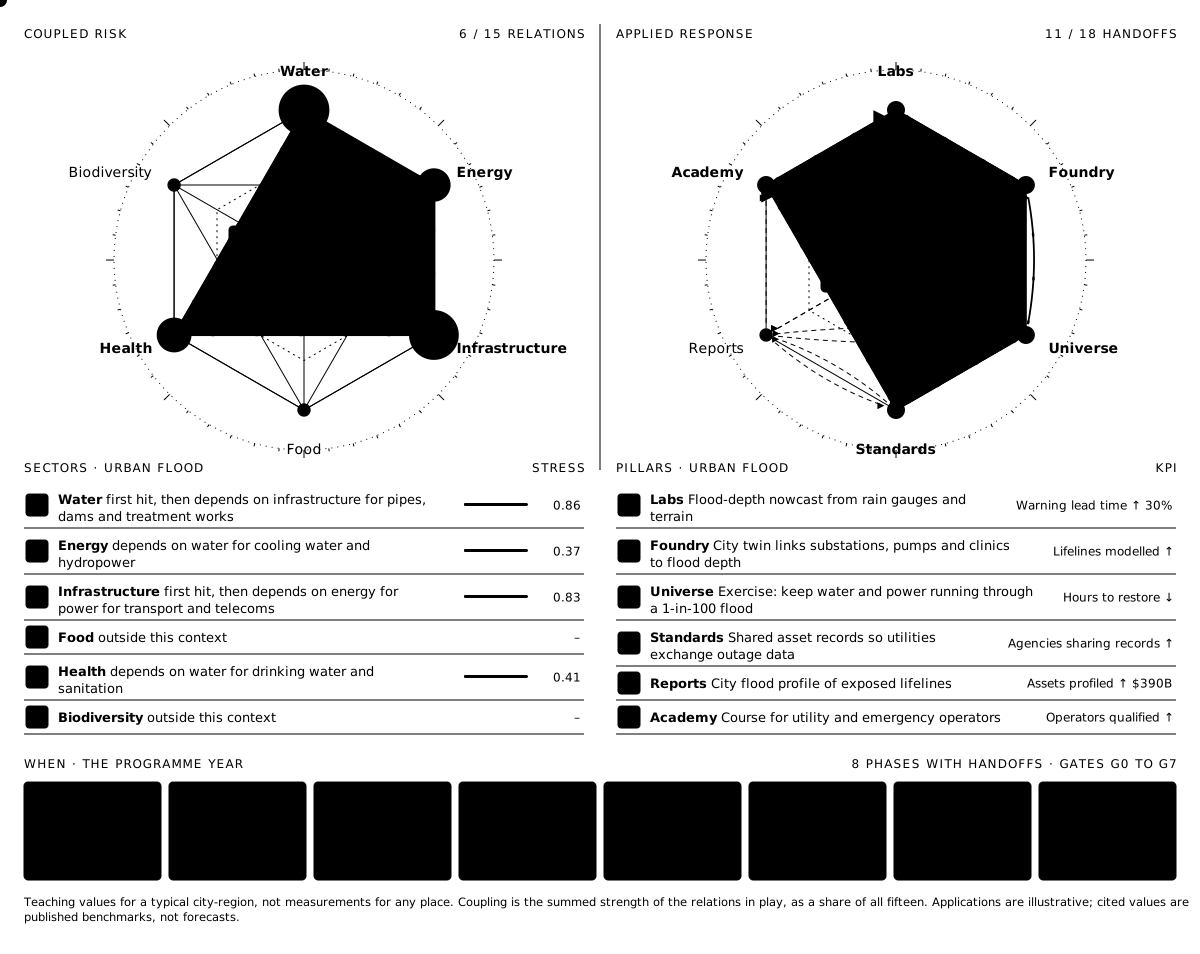
<figure><picture><source srcset="/files/hrcAUCzv1HJtHVOu21fg" media="(prefers-color-scheme: dark)"><img src="https://2655483226-files.gitbook.io/~/files/v0/b/gitbook-x-prod.appspot.com/o/spaces%2FEQtittnb4JJQ2YOtd2tk%2Fuploads%2Fgit-blob-29bf1a618aa7e5c86e61d26acb582e31181bca52%2Fnexus-duo-urban-flood-light.svg?alt=media" alt="Two hexagons. Left, coupled risk: in an urban flood, water and infrastructure are hit first; four of the six sectors (water, energy, infrastructure, health) are in play through six of the fifteen relations, and the teaching cascade amplifies the initial shock 2.06 times. Right, applied response: five of the six programme pillars apply to the context (Labs, Foundry, Universe, Standards, Academy), with eleven of the eighteen handoffs between them in play; each pillar answers for one measure, and the cited return on resilient infrastructure is about four to one. Underneath, the eight phases of the programme year in which handoffs happen."></picture><figcaption><p><strong>Coupled risk, applied response: urban flood.</strong> The same model and values as the GCRI, GRF and GRA home pages. Left: teaching values for a typical city-region, not measurements. Right: illustrative applications and the measure each pillar answers for; values are published benchmarks (World Bank, Lifelines, 2019; Global Commission on Adaptation, Adapt Now, 2019), not forecasts. Source: the sectors and pillars model published on the GCRI, GRF and GRA home pages, vendored and hash-pinned in tools/figures/vendor/nexus-model. As of 2026-10-21.</p></figcaption></figure>

<details>

<summary>Figure data (text alternative)</summary>

| Element                   | Kind             | Description                                                                                                                                                         | Value                                                                                                                 |
| ------------------------- | ---------------- | ------------------------------------------------------------------------------------------------------------------------------------------------------------------- | --------------------------------------------------------------------------------------------------------------------- |
| Water and Energy          | Relation in play | Water to energy: cooling water and hydropower (0.6); Energy to water: pumping and treatment (0.5)                                                                   | 0.55                                                                                                                  |
| Water and Infrastructure  | Relation in play | Water to infrastructure: erosion and flood damage (0.3); Infrastructure to water: pipes, dams and treatment works (0.6)                                             | 0.45                                                                                                                  |
| Water and Health          | Relation in play | Water to health: drinking water and sanitation (0.7); Health to water: utility workforce (0.2)                                                                      | 0.45                                                                                                                  |
| Energy and Infrastructure | Relation in play | Energy to infrastructure: power for transport and telecoms (0.8); Infrastructure to energy: transmission and fuel logistics (0.6)                                   | 0.70                                                                                                                  |
| Energy and Health         | Relation in play | Energy to health: hospital power (0.5); Health to energy: grid workforce (0.2)                                                                                      | 0.35                                                                                                                  |
| Infrastructure and Health | Relation in play | Infrastructure to health: access to care (0.5); Health to infrastructure: workforce for operations (0.3)                                                            | 0.40                                                                                                                  |
| Water                     | Sector           | first hit, then depends on infrastructure for pipes, dams and treatment works                                                                                       | stress 0.86                                                                                                           |
| Energy                    | Sector           | depends on water for cooling water and hydropower                                                                                                                   | stress 0.37                                                                                                           |
| Infrastructure            | Sector           | first hit, then depends on energy for power for transport and telecoms                                                                                              | stress 0.83                                                                                                           |
| Food                      | Sector           | outside this context                                                                                                                                                | –                                                                                                                     |
| Health                    | Sector           | depends on water for drinking water and sanitation                                                                                                                  | stress 0.41                                                                                                           |
| Biodiversity              | Sector           | outside this context                                                                                                                                                | –                                                                                                                     |
| Amplification             | Cascade          | Shock 0.6 at Water and Infrastructure, gain 0.35, 4 rounds; coupling 0.46 of the total                                                                              | ×2.06                                                                                                                 |
| F01                       | Handoff in play  | Universe to Foundry: Admitted mission becomes a cycle project with a decision case                                                                                  | Readiness preparation                                                                                                 |
| F02                       | Handoff in play  | Foundry to Universe: Core Build Report and go or no-go evidence                                                                                                     | Controlled build                                                                                                      |
| F03                       | Handoff          | Foundry to Reports: Sealed observations and indicator series behind a profile                                                                                       | Closeout                                                                                                              |
| F04                       | Handoff          | Universe to Reports: After-action and scenario findings for chapters 10 and 13                                                                                      | After-action review                                                                                                   |
| F05                       | Handoff          | Foundry to Reports: National Portfolio movement for chapter 11                                                                                                      | After-action review                                                                                                   |
| F06                       | Handoff          | Reports to Standards: Method and correction findings as change proposals                                                                                            | Correction                                                                                                            |
| F07                       | Handoff in play  | Universe to Standards: Docket items that need a standard or a profile                                                                                               | Docket review                                                                                                         |
| F08                       | Handoff in play  | Standards to Foundry: Composed mission profiles and national adoption records                                                                                       | Readiness preparation                                                                                                 |
| F09                       | Handoff in play  | Standards to Academy: Each adopted standard or profile becomes a course module                                                                                      | Renewal                                                                                                               |
| F10                       | Handoff in play  | Universe to Academy: Assessed cycle tasks become completion evidence                                                                                                | Closeout                                                                                                              |
| F11                       | Handoff in play  | Academy to Universe: Qualified participants for the next cycle's roles                                                                                              | Renewal                                                                                                               |
| F12                       | Handoff          | Reports to Universe: Q4 synthesis informs the next-year mandate                                                                                                     | Renewal                                                                                                               |
| F13                       | Handoff in play  | Foundry to Standards: Validation and monitoring evidence for conformance review                                                                                     | Controlled build                                                                                                      |
| F14                       | Handoff in play  | Foundry to Academy: Each system's rooms become a learning-by-doing course                                                                                           | Planning                                                                                                              |
| R1                        | Handoff          | Standards to Reports: Applied in editions                                                                                                                           | Around the ring                                                                                                       |
| R2                        | Handoff          | Reports to Academy: Taught in the open                                                                                                                              | Around the ring                                                                                                       |
| R3                        | Handoff in play  | Academy to Labs: Questions become experiments                                                                                                                       | Around the ring                                                                                                       |
| R4                        | Handoff in play  | Labs to Foundry: Tested prototypes are built                                                                                                                        | Around the ring                                                                                                       |
| Labs                      | Pillar           | Flood-depth nowcast from rain gauges and terrain                                                                                                                    | Warning lead time ↑ 30%                                                                                               |
| Foundry                   | Pillar           | City twin links substations, pumps and clinics to flood depth                                                                                                       | Lifelines modelled ↑                                                                                                  |
| Universe                  | Pillar           | Exercise: keep water and power running through a 1-in-100 flood                                                                                                     | Hours to restore ↓                                                                                                    |
| Standards                 | Pillar           | Shared asset records so utilities exchange outage data                                                                                                              | Agencies sharing records ↑                                                                                            |
| Reports                   | Pillar           | City flood profile of exposed lifelines                                                                                                                             | Assets profiled ↑ $390B                                                                                               |
| Academy                   | Pillar           | Course for utility and emergency operators                                                                                                                          | Operators qualified ↑                                                                                                 |
| Value at risk             | Cited value      | At least, by households and firms in low- and middle-income countries to infrastructure disruptions. World Bank, Lifelines, 2019                                    | $390B a year at least, in infrastructure disruption costs to households and firms in low- and middle-income countries |
| Return on resilience      | Cited value      | Net benefit of more resilient infrastructure in developing countries, over the life of the assets. World Bank, Lifelines, 2019                                      | 4 : 1 benefit to cost                                                                                                 |
| Avoided loss              | Cited value      | With 24 hours' warning of a coming storm or heatwave. Global Commission on Adaptation, Adapt Now, 2019                                                              | 30% less damage with 24 hours' warning of a storm or heatwave                                                         |
| Planning                  | Phase (Q1, G0)   | F14 Each system's rooms become a learning-by-doing course                                                                                                           | 1 handoff(s)                                                                                                          |
| Readiness preparation     | Phase (Q2, G2)   | F01 Admitted mission becomes a cycle project with a decision case; F08 Composed mission profiles and national adoption records                                      | 2 handoff(s)                                                                                                          |
| Controlled build          | Phase (Q2, G3)   | F02 Core Build Report and go or no-go evidence; F13 Validation and monitoring evidence for conformance review                                                       | 2 handoff(s)                                                                                                          |
| Closeout                  | Phase (Q3, G5)   | F03 Sealed observations and indicator series behind a profile; F10 Assessed cycle tasks become completion evidence                                                  | 2 handoff(s)                                                                                                          |
| After-action review       | Phase (Q3)       | F04 After-action and scenario findings for chapters 10 and 13; F05 National Portfolio movement for chapter 11                                                       | 2 handoff(s)                                                                                                          |
| Correction                | Phase (Q4)       | F06 Method and correction findings as change proposals                                                                                                              | 1 handoff(s)                                                                                                          |
| Docket review             | Phase (Q4)       | F07 Docket items that need a standard or a profile                                                                                                                  | 1 handoff(s)                                                                                                          |
| Renewal                   | Phase (Q4, G7)   | F09 Each adopted standard or profile becomes a course module; F11 Qualified participants for the next cycle's roles; F12 Q4 synthesis informs the next-year mandate | 3 handoff(s)                                                                                                          |

</details>

## The thesis

Three observations from the research on systemic risk organise the model.

1. **Failure is relational.** Infrastructure systems depend on one another physically, digitally, geographically and through shared logic, and a disturbance in one can propagate to others that were never directly hit (Rinaldi, Peerenboom and Kelly, [2001](https://doi.org/10.1109/37.969131)). Coupled networks can fail more abruptly than any single network would (Buldyrev et al., [2010](https://doi.org/10.1038/nature08932)). The unit of analysis is therefore the relation between sectors, not the sector alone.
2. **Hazards compound and cascade.** Climate-related extremes increasingly occur together or in sequence, and their combined impact exceeds the sum of their parts (Zscheischler et al., [2018](https://doi.org/10.1038/s41558-018-0156-3); IPCC, [2022](https://www.ipcc.ch/report/ar6/wg2/)). Cascading effects follow the vulnerabilities built into social and technical systems, and they can be read and reduced in advance (Pescaroli and Alexander, [2016](https://doi.org/10.1007/s11069-016-2186-3), [2018](https://doi.org/10.1111/risa.13128)). The UN's assessments of global risk now treat this systemic character as the central problem of risk governance (UNDRR, [2019](https://www.undrr.org/publication/global-assessment-report-disaster-risk-reduction-2019), [2022](https://www.undrr.org/gar2022-our-world-risk)).
3. **Coupled risk needs a coupled response.** No single institution observes, models, tests, codifies, publishes and teaches at once. Governments have agreed to strengthen risk governance across sectors and to invest in resilience (UN General Assembly, [2015](https://www.undrr.org/publication/sendai-framework-disaster-risk-reduction-2015-2030)), and the OECD asks its members to govern critical risks through whole-of-society approaches (OECD, [2014](https://legalinstruments.oecd.org/en/instruments/OECD-LEGAL-0405)). The programme answers with six pillars that hand work to one another on a published schedule, so that what one pillar learns becomes another's input.

The two hexagons share one geometry on purpose. On the left, a context such as urban flood selects the sectors in play and the relations between them. On the right, the same context selects the pillars that apply, the measure each answers for, and the handoffs between them. The page a reader is on always sits somewhere on this pair: a sector, a pillar, a handoff, a phase of the year, or an institution that carries them.

{% hint style="info" %}
**What the figures are, and are not.** The relation strengths and the cascade are **teaching values for a typical city-region, not measurements for any place**. The pillar applications are illustrative, and the values in the right-hand panel are published benchmarks, cited, never forecasts. A country replaces the teaching values with its own evidence through its National Model. See [Method and limits](/organization/model/method-and-limits.md).
{% endhint %}

## Pages in this part

<table data-view="cards"><thead><tr><th></th><th></th><th data-hidden data-card-target data-type="content-ref"></th></tr></thead><tbody><tr><td><strong>Coupled risk</strong></td><td>Six sectors, thirty directed relations, the teaching cascade and how to read amplification.</td><td><a href="/organization/model/coupled-risk.md">Coupled risk</a></td></tr><tr><td><strong>Applied response</strong></td><td>Six pillars, eighteen handoffs, the feedback loops and the routes through the programme.</td><td><a href="/organization/model/applied-response.md">Applied response</a></td></tr><tr><td><strong>Sectors</strong></td><td>Water, energy, infrastructure, food, health and biodiversity, each with what it gives and receives.</td><td><a href="/organization/model/sectors.md">Sectors</a></td></tr><tr><td><strong>Scenarios</strong></td><td>Eight teaching contexts, from urban flood to pollinator decline, each with both hexagons.</td><td><a href="/organization/model/scenarios.md">Scenarios</a></td></tr><tr><td><strong>Method and limits</strong></td><td>Assumptions, the four kinds of number on these pages, and how a country brings its own evidence.</td><td><a href="/organization/model/method-and-limits.md">Method and limits</a></td></tr></tbody></table>

## Where the model goes next

| To read about                                                  | Go to                                                                                                                                                                               |
| -------------------------------------------------------------- | ----------------------------------------------------------------------------------------------------------------------------------------------------------------------------------- |
| Each pillar's role, records, boundary and year                 | [Programme](/organization/programme.md)                                                                                                                                             |
| The programme year: quarters, phases, gates G0 to G7           | [The programme year](/organization/programme/the-programme-year.md)                                                                                                                 |
| Who carries the model: GCRI, GRF, GRA and the Nexus Consortium | [Institutions](/organization/institutions.md)                                                                                                                                       |
| The model on the public sites                                  | [GCRI home](https://therisk.global/), [GRF home](https://globalriskforum.com/), [GRA home](https://globalriskalliance.com/), [How Nexus works](https://therisk.global/nexus-cycle/) |

## Sources

* Buldyrev, S. V., Parshani, R., Paul, G., Stanley, H. E. and Havlin, S. (2010). Catastrophic cascade of failures in interdependent networks. *Nature* 464: 1025–1028. <https://doi.org/10.1038/nature08932>
* IPCC (2022). *Climate Change 2022: Impacts, Adaptation and Vulnerability.* Working Group II contribution to the Sixth Assessment Report. <https://www.ipcc.ch/report/ar6/wg2/>
* OECD (2014). *Recommendation of the Council on the Governance of Critical Risks.* OECD/LEGAL/0405. <https://legalinstruments.oecd.org/en/instruments/OECD-LEGAL-0405>
* Pescaroli, G. and Alexander, D. (2016). Critical infrastructure, panarchies and the vulnerability paths of cascading disasters. *Natural Hazards* 82: 175–192. <https://doi.org/10.1007/s11069-016-2186-3>
* Pescaroli, G. and Alexander, D. (2018). Understanding compound, interconnected, interacting, and cascading risks: a holistic framework. *Risk Analysis* 38(11): 2245–2257. <https://doi.org/10.1111/risa.13128>
* Rinaldi, S. M., Peerenboom, J. P. and Kelly, T. K. (2001). Identifying, understanding, and analyzing critical infrastructure interdependencies. *IEEE Control Systems Magazine* 21(6): 11–25. <https://doi.org/10.1109/37.969131>
* UN General Assembly (2015). *Sendai Framework for Disaster Risk Reduction 2015–2030.* A/RES/69/283. <https://www.undrr.org/publication/sendai-framework-disaster-risk-reduction-2015-2030>
* UNDRR (2019). *Global Assessment Report on Disaster Risk Reduction 2019.* <https://www.undrr.org/publication/global-assessment-report-disaster-risk-reduction-2019>
* UNDRR (2022). *Global Assessment Report on Disaster Risk Reduction 2022: Our World at Risk.* <https://www.undrr.org/gar2022-our-world-risk>
* Zscheischler, J. et al. (2018). Future climate risk from compound events. *Nature Climate Change* 8: 469–477. <https://doi.org/10.1038/s41558-018-0156-3>
* The model: the "Coupled risk, applied response" section of the [GCRI home page](https://therisk.global/), drawn from the same data as the figures here.


---

# Agent Instructions
This documentation is published with GitBook. GitBook is the documentation platform designed so that both humans and AI agents can read, navigate, and reason over technical content effectively. Learn more at gitbook.com.

## Querying This Documentation
If you need additional information that is not directly available in this page, you can query the documentation by asking a question.

Perform an HTTP GET request on the following URL with the `ask` and `goal` query parameters:

```
GET https://docs.therisk.global/organization/model.md?ask=<question>&goal=<user_goal>
```

`ask` is the immediate question: it should be specific, self-contained, and written in natural language.
`goal` is what the user is ultimately trying to achieve, the reason they need the answer. Sharing it helps GitBook give you a better, more relevant answer. A goal is most helpful when it describes the outcome the user wants rather than restating the question. For example, with `ask=how do I create an API token`, a goal like `automate deployments from our CI pipeline` lets GitBook tailor the answer to that use case.

The response will contain a direct answer to the question and relevant excerpts and sources from the documentation.

Use this mechanism when the answer is not explicitly present in the current page, you need clarification or additional context, or you want to retrieve related documentation sections.
