> For the complete documentation index, see [llms.txt](https://docs.therisk.global/organization/llms.txt). Markdown versions of documentation pages are available by appending `.md` to page URLs; this page is available as [Markdown](https://docs.therisk.global/organization/programme/the-nexus-cycle.md).

# The Nexus cycle

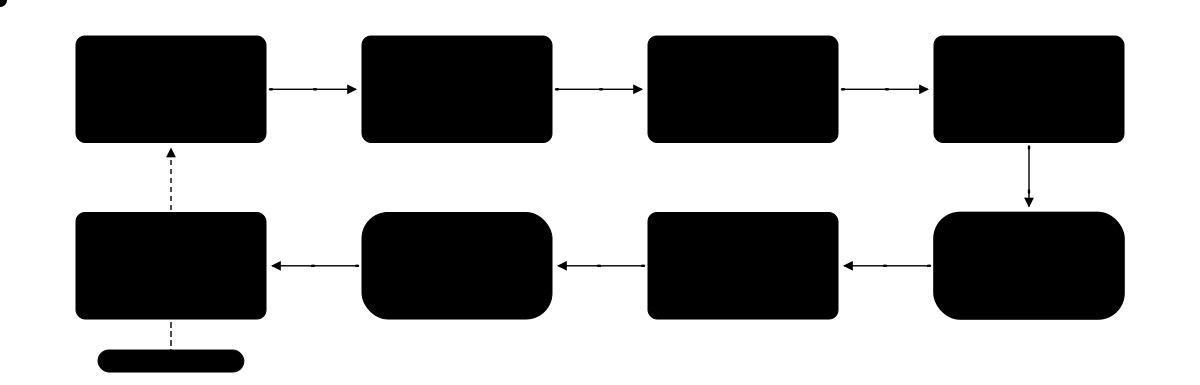
The Nexus cycle: eight steps from a question to renewal, each in the pillar that runs it, with the decision left to the competent authority outside the programme.

*Where this fits: applied response, as a method. Pillars:* [*Nexus Universe*](/organization/programme/universe.md)*, Foundry,* [*Nexus Reports*](/organization/programme/reports.md)*. Institutions: GCRI, GRF, GRA; the competent authority outside the programme. Cycle: all eight steps. Kind: programme page.*

**In brief.** Every piece of work in the programme follows one cycle of eight steps: Question, Evidence, Build, Organize, Test, Publish, Decide and Renew ([How Nexus works](https://therisk.global/nexus-cycle/)). Each step runs in a pillar: Nexus Universe frames the question, organizes the communities, tests in controlled exercise and renews the agenda; the [Foundry pillar](/organization/programme/foundry.md) gathers the evidence and builds; Nexus Reports publishes. One step does not belong to the programme. **Decide** belongs to the competent authority or institution, under its own rules. The cycle supplies evidence and options; it does not decide.

<figure><picture><source srcset="/files/Aqjsu7ujnKYWHObBzVMt" media="(prefers-color-scheme: dark)"><img src="https://2655483226-files.gitbook.io/~/files/v0/b/gitbook-x-prod.appspot.com/o/spaces%2FEQtittnb4JJQ2YOtd2tk%2Fuploads%2Fgit-blob-7b7d6e965861efebeccea863916eb1fabd750a49%2Fprogramme-nexus-cycle-light.svg?alt=media" alt="Eight steps in order: Question in Nexus Universe, Evidence and Build in Foundry, Organize and Test in Nexus Universe, Publish in Nexus Reports, Decide by the competent authority outside the programme, and Renew in Nexus Universe, after which the cycle begins again with corrections and the next annual agenda. Each step links to its page on therisk.global."></picture><figcaption><p><strong>The Nexus cycle, step by step and lane by lane.</strong> The order and lanes as published on the GCRI site. The programme supplies evidence and options; the competent authority decides under its own rules. Source: therisk.global/nexus-cycle/, sections 01 and 06, via the canonical URL registry. As of 2026-10-21.</p></figcaption></figure>

<details>

<summary>Figure data (text alternative)</summary>

| Element  | Description                                           | Connected to       |
| -------- | ----------------------------------------------------- | ------------------ |
| Question | Universe · a priority becomes a researchable question | Evidence           |
| Evidence | Foundry · methods, labelled data, uncertainty         | Question; Build    |
| Build    | Foundry · versioned models and data                   | Evidence; Organize |
| Organize | Universe · communities and working groups             | Build; Test        |
| Test     | Universe · controlled exercise, gated                 | Organize; Publish  |
| Publish  | Reports · findings with their limits                  | Test; Decide       |
| Decide   | Competent authority · outside the programme           | Publish; Renew     |
| Renew    | Universe · corrections and the next agenda            | Decide             |

</details>

## The eight steps

| Step                                                     | Lane                                        | What happens                                                                                        | What GCRI contributes                                                                                                | Risk-management analogue         |
| -------------------------------------------------------- | ------------------------------------------- | --------------------------------------------------------------------------------------------------- | -------------------------------------------------------------------------------------------------------------------- | -------------------------------- |
| [Question](https://therisk.global/nexus-cycle/question/) | Nexus Universe                              | A national, regional or institutional priority becomes a researchable question with stated criteria | Turns priorities into researchable questions                                                                         | Scope, context and criteria      |
| [Evidence](https://therisk.global/nexus-cycle/evidence/) | Foundry                                     | Methods, labelled data and uncertainty are assembled                                                | Supplies the methods, data and evidence labels                                                                       | Risk identification and analysis |
| [Build](https://therisk.global/nexus-cycle/build/)       | Foundry                                     | Authorised projects build versioned models and analysis                                             | Runs the Foundry pillar on the [Nexus systems](/organization/systems.md)                                             | Analysis tooling                 |
| [Organize](https://therisk.global/nexus-cycle/organize/) | Nexus Universe                              | Specialist communities and national working groups are organized around the question                | Organizes the specialist communities and the [National Working Groups](/organization/governance-in-operation/nwg.md) | (Consortium bodies)              |
| [Test](https://therisk.global/nexus-cycle/test/)         | Nexus Universe                              | The build is exercised under control, at a recorded gate                                            | Provides the technical office for tests                                                                              | Exercising and validation        |
| [Publish](https://therisk.global/nexus-cycle/publish/)   | Nexus Reports                               | Findings are published with their method, uncertainty and limits                                    | Edits Nexus Reports                                                                                                  | Recording and reporting          |
| [Decide](https://therisk.global/nexus-cycle/decide/)     | Competent authority (outside the programme) | The authority or institution decides under its own rules                                            | Hands evidence to competent authorities                                                                              | (The authority's own process)    |
| [Renew](https://therisk.global/nexus-cycle/renew/)       | Nexus Universe                              | Corrections and lessons feed the next annual agenda                                                 | Records corrections and feeds lessons into the next agenda                                                           | Monitoring and review            |

Steps, lanes and contributions as stated on [How Nexus works](https://therisk.global/nexus-cycle/), sections 01 and 06.

## Why a loop

Risk-management standards describe a loop rather than a line: scope and context, assessment, treatment, monitoring and review, and recording and reporting ([ISO, 2018](https://www.iso.org/standard/65694.html)). The UNDRR terminology frames disaster risk as a function of hazard, exposure, vulnerability and capacity, each of which changes over time ([UNDRR, 2017](https://www.undrr.org/drr-glossary/terminology)), so an assessment that is not renewed falls out of date. A cascading or compound risk crosses sectors ([Pescaroli and Alexander, 2018](https://doi.org/10.1111/risa.13128)), so the loop has to be run with several owners rather than one: that is why each step sits in a pillar, and why the decision sits outside them.

## The cycle and the programme year

The cycle is the shape of any one piece of work; the [programme year](/organization/programme/the-programme-year.md) is the calendar on which the Consortium runs all of them together. A question admitted at G1 is evidenced and built in readiness preparation and the controlled build, organized and tested in Action Week (G4), published in the quarterly editions and authorised at G6, and renewed at G7, when the findings of the year set the next mandate. Decisions taken by competent authorities on the strength of that evidence fall outside both: the programme records them only where the authority chooses to share them.

## Read further

* [The programme year](/organization/programme/the-programme-year.md): the twelve phases and eight gates.
* [Programme](/organization/programme.md): the six pillars.
* [Start here](/organization/introduction/start-here.md): the model in one picture.

## Sources

* GCRI, [How Nexus works](https://therisk.global/nexus-cycle/) and its eight step pages, as of 2026-10-21.
* ISO (2018). [ISO 31000:2018 Risk management: Guidelines](https://www.iso.org/standard/65694.html). Geneva: International Organization for Standardization.
* UNDRR (2017). [Terminology on disaster risk reduction](https://www.undrr.org/drr-glossary/terminology), from the report of the open-ended intergovernmental expert working group on indicators and terminology (A/71/644), endorsed by UN General Assembly resolution 71/276.
* Pescaroli, G. and Alexander, D. (2018). Understanding compound, interconnected, interacting, and cascading risks: a holistic framework. *Risk Analysis* 38(11): 2245–2257. [doi:10.1111/risa.13128](https://doi.org/10.1111/risa.13128).


---

# Agent Instructions
This documentation is published with GitBook. GitBook is the documentation platform designed so that both humans and AI agents can read, navigate, and reason over technical content effectively. Learn more at gitbook.com.

## Querying This Documentation
If you need additional information that is not directly available in this page, you can query the documentation by asking a question.

Perform an HTTP GET request on the following URL with the `ask` and `goal` query parameters:

```
GET https://docs.therisk.global/organization/programme/the-nexus-cycle.md?ask=<question>&goal=<user_goal>
```

`ask` is the immediate question: it should be specific, self-contained, and written in natural language.
`goal` is what the user is ultimately trying to achieve, the reason they need the answer. Sharing it helps GitBook give you a better, more relevant answer. A goal is most helpful when it describes the outcome the user wants rather than restating the question. For example, with `ask=how do I create an API token`, a goal like `automate deployments from our CI pipeline` lets GitBook tailor the answer to that use case.

The response will contain a direct answer to the question and relevant excerpts and sources from the documentation.

Use this mechanism when the answer is not explicitly present in the current page, you need clarification or additional context, or you want to retrieve related documentation sections.
