> For the complete documentation index, see [llms.txt](https://docs.therisk.global/organization/llms.txt). Markdown versions of documentation pages are available by appending `.md` to page URLs; this page is available as [Markdown](https://docs.therisk.global/organization/model/scenarios/heatwave.md).

# Heatwave

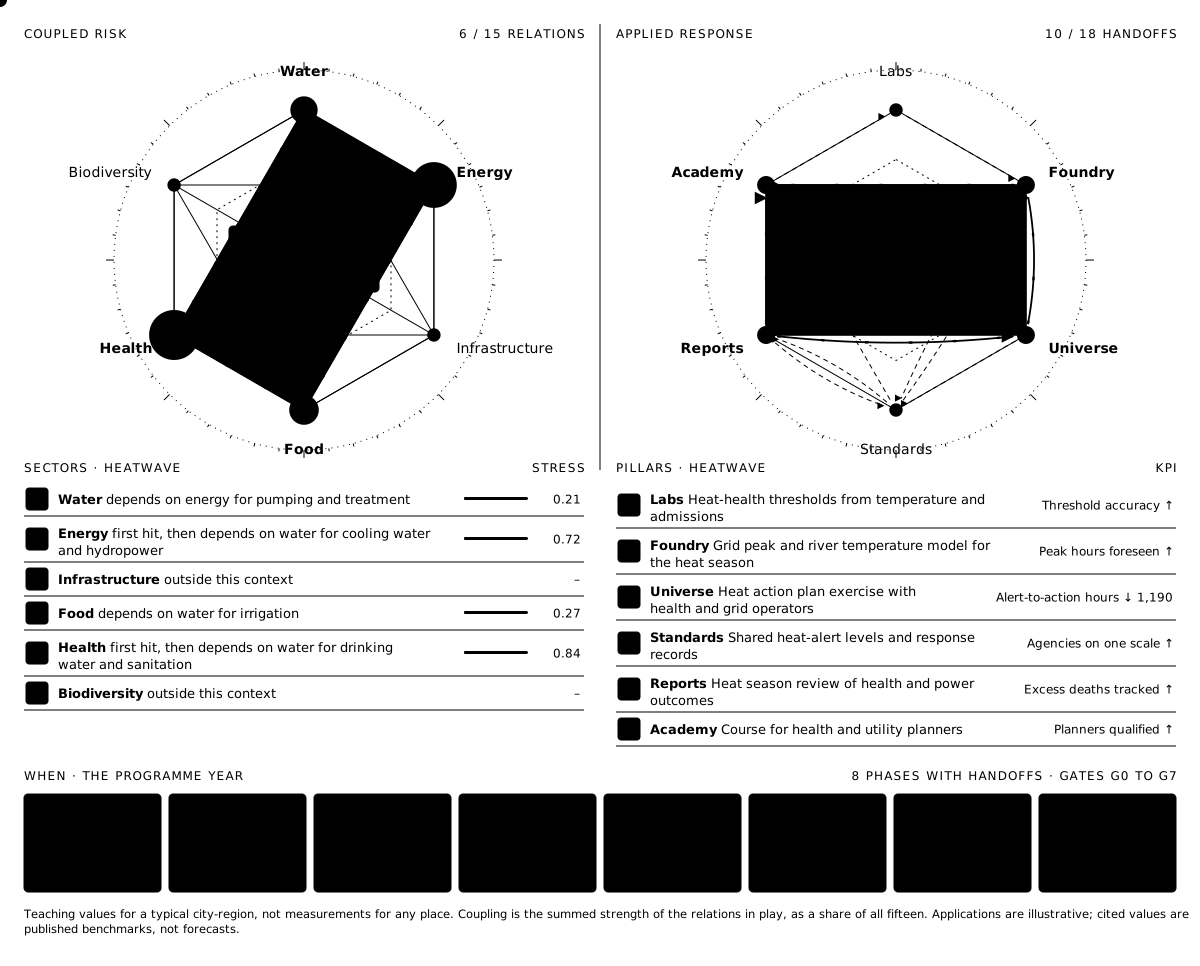
Heatwave: the coupled risk across water, energy, food and health, and the applied response of the programme pillars, as a teaching context of the Nexus model.

**Where this fits:** water, energy, food and health · Foundry, Nexus Universe, Nexus Reports and Risk Academy · the Nexus Consortium · the whole programme year · teaching context.

> Cooling demand peaks the grid while rivers warm; heat stress fills hospitals and wilts crops.

**In brief.** In this teaching context energy and health are hit first. 4 of the six sectors are in play through 6 of the fifteen relations, a coupling of 0.43 of the whole system, and the teaching cascade amplifies the initial shock ×1.69. On the response side, 4 of the six pillars apply, with 10 of the eighteen handoffs in play and 5 feedback loops closed. All sector values are **teaching values for a typical city-region, not measurements for any place**; the applications are illustrative and the cited values are published benchmarks, not forecasts.

<figure><picture><source srcset="/files/6zOhWHD8BRiHB4UPwjIx" media="(prefers-color-scheme: dark)"><img src="https://2655483226-files.gitbook.io/~/files/v0/b/gitbook-x-prod.appspot.com/o/spaces%2FEQtittnb4JJQ2YOtd2tk%2Fuploads%2Fgit-blob-683e4915358c93002e6ae89986a2168987b11453%2Fnexus-duo-heatwave-light.svg?alt=media" alt="Two hexagons for heatwave. Left, coupled risk: energy and health are hit first; 4 of the six sectors (water, energy, food and health) are in play through 6 of the fifteen relations, and the teaching cascade amplifies the initial shock 1.69 times. Right, applied response: 4 of the six programme pillars apply (Foundry, Universe, Reports and Academy), with 10 of the eighteen handoffs between them in play and 5 feedback loops closed; the cited headline value is 1,190 deaths avoided a year. Underneath, the eight phases of the programme year in which handoffs happen."></picture><figcaption><p><strong>Coupled risk, applied response: heatwave.</strong> Left: teaching values for a typical city-region, not measurements. Right: illustrative applications and the measure each pillar answers for; values are published benchmarks (Hess et al., J. Environ. Public Health, 2018), not forecasts. Source: the sectors and pillars model published on the GCRI, GRF and GRA home pages, vendored and hash-pinned in tools/figures/vendor/nexus-model. As of 2026-10-21.</p></figcaption></figure>

<details>

<summary>Figure data (text alternative)</summary>

| Element               | Kind             | Description                                                                                                                                                         | Value                         |
| --------------------- | ---------------- | ------------------------------------------------------------------------------------------------------------------------------------------------------------------- | ----------------------------- |
| Water and Energy      | Relation in play | Water to energy: cooling water and hydropower (0.6); Energy to water: pumping and treatment (0.5)                                                                   | 0.55                          |
| Water and Food        | Relation in play | Water to food: irrigation (0.8); Food to water: withdrawals and runoff (0.3)                                                                                        | 0.55                          |
| Water and Health      | Relation in play | Water to health: drinking water and sanitation (0.7); Health to water: utility workforce (0.2)                                                                      | 0.45                          |
| Energy and Food       | Relation in play | Energy to food: fertiliser, machinery and cold chains (0.5); Food to energy: bioenergy feedstock (0.2)                                                              | 0.35                          |
| Energy and Health     | Relation in play | Energy to health: hospital power (0.5); Health to energy: grid workforce (0.2)                                                                                      | 0.35                          |
| Food and Health       | Relation in play | Food to health: nutrition (0.7); Health to food: farm labour (0.3)                                                                                                  | 0.50                          |
| Water                 | Sector           | depends on energy for pumping and treatment                                                                                                                         | stress 0.21                   |
| Energy                | Sector           | first hit, then depends on water for cooling water and hydropower                                                                                                   | stress 0.72                   |
| Infrastructure        | Sector           | outside this context                                                                                                                                                | –                             |
| Food                  | Sector           | depends on water for irrigation                                                                                                                                     | stress 0.27                   |
| Health                | Sector           | first hit, then depends on water for drinking water and sanitation                                                                                                  | stress 0.84                   |
| Biodiversity          | Sector           | outside this context                                                                                                                                                | –                             |
| Amplification         | Cascade          | Shock 0.6 at Energy and Health, gain 0.35, 4 rounds; coupling 0.43 of the total                                                                                     | ×1.69                         |
| F01                   | Handoff in play  | Universe to Foundry: Admitted mission becomes a cycle project with a decision case                                                                                  | Readiness preparation         |
| F02                   | Handoff in play  | Foundry to Universe: Core Build Report and go or no-go evidence                                                                                                     | Controlled build              |
| F03                   | Handoff in play  | Foundry to Reports: Sealed observations and indicator series behind a profile                                                                                       | Closeout                      |
| F04                   | Handoff in play  | Universe to Reports: After-action and scenario findings for chapters 10 and 13                                                                                      | After-action review           |
| F05                   | Handoff in play  | Foundry to Reports: National Portfolio movement for chapter 11                                                                                                      | After-action review           |
| F06                   | Handoff          | Reports to Standards: Method and correction findings as change proposals                                                                                            | Correction                    |
| F07                   | Handoff          | Universe to Standards: Docket items that need a standard or a profile                                                                                               | Docket review                 |
| F08                   | Handoff          | Standards to Foundry: Composed mission profiles and national adoption records                                                                                       | Readiness preparation         |
| F09                   | Handoff          | Standards to Academy: Each adopted standard or profile becomes a course module                                                                                      | Renewal                       |
| F10                   | Handoff in play  | Universe to Academy: Assessed cycle tasks become completion evidence                                                                                                | Closeout                      |
| F11                   | Handoff in play  | Academy to Universe: Qualified participants for the next cycle's roles                                                                                              | Renewal                       |
| F12                   | Handoff in play  | Reports to Universe: Q4 synthesis informs the next-year mandate                                                                                                     | Renewal                       |
| F13                   | Handoff          | Foundry to Standards: Validation and monitoring evidence for conformance review                                                                                     | Controlled build              |
| F14                   | Handoff in play  | Foundry to Academy: Each system's rooms become a learning-by-doing course                                                                                           | Planning                      |
| R1                    | Handoff          | Standards to Reports: Applied in editions                                                                                                                           | Around the ring               |
| R2                    | Handoff in play  | Reports to Academy: Taught in the open                                                                                                                              | Around the ring               |
| R3                    | Handoff          | Academy to Labs: Questions become experiments                                                                                                                       | Around the ring               |
| R4                    | Handoff          | Labs to Foundry: Tested prototypes are built                                                                                                                        | Around the ring               |
| Labs                  | Pillar           | Heat-health thresholds from temperature and admissions                                                                                                              | Threshold accuracy ↑          |
| Foundry               | Pillar           | Grid peak and river temperature model for the heat season                                                                                                           | Peak hours foreseen ↑         |
| Universe              | Pillar           | Heat action plan exercise with health and grid operators                                                                                                            | Alert-to-action hours ↓ 1,190 |
| Standards             | Pillar           | Shared heat-alert levels and response records                                                                                                                       | Agencies on one scale ↑       |
| Reports               | Pillar           | Heat season review of health and power outcomes                                                                                                                     | Excess deaths tracked ↑       |
| Academy               | Pillar           | Course for health and utility planners                                                                                                                              | Planners qualified ↑          |
| Avoided loss          | Cited value      | Estimated after Ahmedabad's heat action plan, the first in South Asia. Hess et al., J. Environ. Public Health, 2018                                                 | 1,190 deaths avoided a year   |
| Planning              | Phase (Q1, G0)   | F14 Each system's rooms become a learning-by-doing course                                                                                                           | 1 handoff(s)                  |
| Readiness preparation | Phase (Q2, G2)   | F01 Admitted mission becomes a cycle project with a decision case; F08 Composed mission profiles and national adoption records                                      | 2 handoff(s)                  |
| Controlled build      | Phase (Q2, G3)   | F02 Core Build Report and go or no-go evidence; F13 Validation and monitoring evidence for conformance review                                                       | 2 handoff(s)                  |
| Closeout              | Phase (Q3, G5)   | F03 Sealed observations and indicator series behind a profile; F10 Assessed cycle tasks become completion evidence                                                  | 2 handoff(s)                  |
| After-action review   | Phase (Q3)       | F04 After-action and scenario findings for chapters 10 and 13; F05 National Portfolio movement for chapter 11                                                       | 2 handoff(s)                  |
| Correction            | Phase (Q4)       | F06 Method and correction findings as change proposals                                                                                                              | 1 handoff(s)                  |
| Docket review         | Phase (Q4)       | F07 Docket items that need a standard or a profile                                                                                                                  | 1 handoff(s)                  |
| Renewal               | Phase (Q4, G7)   | F09 Each adopted standard or profile becomes a course module; F11 Qualified participants for the next cycle's roles; F12 Q4 synthesis informs the next-year mandate | 3 handoff(s)                  |

</details>

## Coupled risk

| Sector                                                          | In this context                                                    | Stress after four rounds |
| --------------------------------------------------------------- | ------------------------------------------------------------------ | ------------------------ |
| [Water](/organization/model/sectors/water.md)                   | Depends on energy for pumping and treatment                        | 0.21                     |
| [Energy](/organization/model/sectors/energy.md)                 | Hit first; then depends on water for cooling water and hydropower  | 0.72                     |
| [Infrastructure](/organization/model/sectors/infrastructure.md) | Outside this context                                               | –                        |
| [Food](/organization/model/sectors/food.md)                     | Depends on water for irrigation                                    | 0.27                     |
| [Health](/organization/model/sectors/health.md)                 | Hit first; then depends on water for drinking water and sanitation | 0.84                     |
| [Biodiversity](/organization/model/sectors/biodiversity.md)     | Outside this context                                               | –                        |

Amplification ×1.69; 6 of the 15 relations in play; coupling 0.43 of the total. Teaching values for a typical city-region, not measurements for any place. Coupling is the summed strength of the relations in play, as a share of all fifteen.

**What it means for a study.** A heatwave hits energy and health together. Cooling demand peaks the grid as rivers warm and power plants lose cooling water, while heat stress fills hospitals. Health carries the highest stress of any sector in this context.

## Applied response

| Pillar                                                          | Illustrative application                                  | Measure it answers for | Better when | Sectors served       |
| --------------------------------------------------------------- | --------------------------------------------------------- | ---------------------- | ----------- | -------------------- |
| [Labs](/organization/programme/labs.md)                         | Heat-health thresholds from temperature and admissions    | Threshold accuracy     | higher      | Health               |
| [Foundry](/organization/programme/foundry.md) (applied)         | Grid peak and river temperature model for the heat season | Peak hours foreseen    | higher      | Water, Energy        |
| [Nexus Universe](/organization/programme/universe.md) (applied) | Heat action plan exercise with health and grid operators  | Alert-to-action hours  | lower       | Energy, Health       |
| [Nexus Standards](/organization/programme/standards.md)         | Shared heat-alert levels and response records             | Agencies on one scale  | higher      | Energy, Health       |
| [Nexus Reports](/organization/programme/reports.md) (applied)   | Heat season review of health and power outcomes           | Excess deaths tracked  | higher      | Health               |
| [Risk Academy](/organization/programme/academy.md) (applied)    | Course for health and utility planners                    | Planners qualified     | higher      | Energy, Food, Health |

**What it means for a response.** The response is a heat action plan that health and grid operators run together. The Foundry foresees grid peaks and river temperatures for the heat season; Universe exercises the hours from alert to action; Reports reviews health and power outcomes after each season; Academy qualifies health and utility planners. The cited benchmark is the heat action plan of Ahmedabad, the first in South Asia. In every case the responsible government, operator or licensed institution decides and acts; the programme informs that decision.

## Published benchmarks

| Slot                 | Value                       | What it measures                                                      | Source                                                                               |
| -------------------- | --------------------------- | --------------------------------------------------------------------- | ------------------------------------------------------------------------------------ |
| Value at risk        | –                           | No published benchmark for this context                               | –                                                                                    |
| Return on resilience | –                           | No published benchmark for this context                               | –                                                                                    |
| Avoided loss         | 1,190 deaths avoided a year | Estimated after Ahmedabad's heat action plan, the first in South Asia | [Hess et al., J. Environ. Public Health, 2018](https://doi.org/10.1155/2018/7973519) |

Each value is international evidence with its own scope, cited on the same line. None is a forecast for any project or place. See [Method and limits](/organization/model/method-and-limits.md) for how to read the values precisely.

## On the public sites

The same context, with the same values, is shown on the [GCRI platforms](https://therisk.global/platforms/) page.

## Related pages

[All scenarios](/organization/model/scenarios.md) · [Coupled risk](/organization/model/coupled-risk.md) · [Applied response](/organization/model/applied-response.md) · [Water](/organization/model/sectors/water.md) · [Energy](/organization/model/sectors/energy.md) · [Food](/organization/model/sectors/food.md) · [Health](/organization/model/sectors/health.md)

## Sources

* Hess et al., J. Environ. Public Health, 2018. <https://doi.org/10.1155/2018/7973519>
* The model data: the "Coupled risk, applied response" section of the [GCRI home page](https://therisk.global/).


---

# Agent Instructions
This documentation is published with GitBook. GitBook is the documentation platform designed so that both humans and AI agents can read, navigate, and reason over technical content effectively. Learn more at gitbook.com.

## Querying This Documentation
If you need additional information that is not directly available in this page, you can query the documentation by asking a question.

Perform an HTTP GET request on the following URL with the `ask` and `goal` query parameters:

```
GET https://docs.therisk.global/organization/model/scenarios/heatwave.md?ask=<question>&goal=<user_goal>
```

`ask` is the immediate question: it should be specific, self-contained, and written in natural language.
`goal` is what the user is ultimately trying to achieve, the reason they need the answer. Sharing it helps GitBook give you a better, more relevant answer. A goal is most helpful when it describes the outcome the user wants rather than restating the question. For example, with `ask=how do I create an API token`, a goal like `automate deployments from our CI pipeline` lets GitBook tailor the answer to that use case.

The response will contain a direct answer to the question and relevant excerpts and sources from the documentation.

Use this mechanism when the answer is not explicitly present in the current page, you need clarification or additional context, or you want to retrieve related documentation sections.
