> For the complete documentation index, see [llms.txt](https://docs.therisk.global/organization/llms.txt). Markdown versions of documentation pages are available by appending `.md` to page URLs; this page is available as [Markdown](https://docs.therisk.global/organization/institutions/grf.md).

# The Global Risks Forum (GRF)

The Global Risks Forum (GRF): a Swiss association and independent consortium steward for leadership, institutional dialogue and the stewardship of Nexus Universe; its four programme decisions, council

**Where this fits.** Institution: GRF. Pillar: Nexus Universe (programme steward); contributes to Reports (publication authorisation at gate G6). Phases: the mandate (G0), mission admission (G1), every gate to G7. Levels: global and regional councils, and the leadership pillar of each National Nexus. Kind: institutional reference.

## In brief

The Global Risks Forum (GRF) is a Swiss association with a public-good, not-for-profit purpose, with its published location in Zug. It is one of the three pillar institutions of the Nexus Consortiums and a consortium steward with an independent mandate. GRF leads leadership, institutional dialogue and the stewardship of Nexus Universe, the annual programme. Within its instruments it holds four programme decisions: the annual mandate, mission admission, the gate decisions G0 to G7 and publication authorisation. GRF does not regulate, finance, procure or certify, and hosting or sponsorship of any part of the programme confers no authority. A forum that convenes ministries and regulators is never one of them ([Institutional status](https://globalriskforum.com/about/institutional-status/)).

## Identity

| Item                          | As published                                                                                                                                                                                                                   |
| ----------------------------- | ------------------------------------------------------------------------------------------------------------------------------------------------------------------------------------------------------------------------------ |
| Legal form                    | A Swiss association with a public-good, not-for-profit purpose, governed by its statutory organs under its articles of association and the Swiss Civil Code                                                                    |
| Published location            | 6300 Zug, Switzerland. The registered street address is kept in the association's legal records                                                                                                                                |
| Role in the Nexus Consortiums | Pillar institution and consortium steward for leadership, institutional dialogue and Nexus Universe stewardship                                                                                                                |
| What it is not                | Not a government body, an intergovernmental body or a diplomatic mission; not a regulator, licensing or certifying body; not a financial institution; not a contracting party for GCRI Canada; claims no host-state privileges |
| Recorded external statuses    | None at present. A status will appear on GRF's own page only with a record                                                                                                                                                     |
| Sources                       | [Swiss association identity](https://globalriskforum.com/about/swiss-association/); [Institutional status](https://globalriskforum.com/about/institutional-status/)                                                            |

In public prose this documentation uses the public name The Global Risks Forum, as NDS-3.2 requires; the registered legal name is used only where an instrument is reproduced.

## The four decisions GRF holds

GRF's role in Nexus Universe is modelled on exercise direction: the director who sets objectives and admits participants is kept apart from the technical controllers who run the scenario and the evaluators who judge performance. GRF holds direction and admission; GCRI's technical office runs the simulation environment; evaluation is assigned to people who did not design the scenario ([Programme governance](https://globalriskforum.com/nexus-universe/grf-role/)). This follows established exercise practice (WHO, 2017).

| Decision                  | Gate     | What is decided                                                                                                                   | Limit                                                                                                          |
| ------------------------- | -------- | --------------------------------------------------------------------------------------------------------------------------------- | -------------------------------------------------------------------------------------------------------------- |
| The annual mandate        | G0       | Scope, participating structures, evaluation questions and publication intentions of an edition                                    | Never sets a national agenda                                                                                   |
| Mission admission         | G1       | Which missions enter the edition, with reasons recorded, after testing inclusion, institutional fit and public-purpose legitimacy | Cannot admit a mission without an accountable owner                                                            |
| Gate decisions            | G0 to G7 | A recorded decision at every gate; a gate not passed stops the work it governs                                                    | A gate is a programme decision, not a public-authority approval, a certification or a deployment authorisation |
| Publication authorisation | G6       | Publication of results that have passed scientific and editorial review                                                           | Cannot publish personal data                                                                                   |

The gates and the phases they close are generated from the programme model in [The programme year](/organization/programme/the-programme-year.md). What GRF contributes to each pillar:

| Institution | Contribution                                                                                |
| ----------- | ------------------------------------------------------------------------------------------- |
| GCRI        | Its technical office prepares the scientific and data readiness of each mission.            |
| GRF         | Stewards and governs the programme: the mandate, gates G0 to G7, convening and Action Week. |
| GRA         | Runs finance-readiness dialogues on what each mission means for finance and insurance.      |

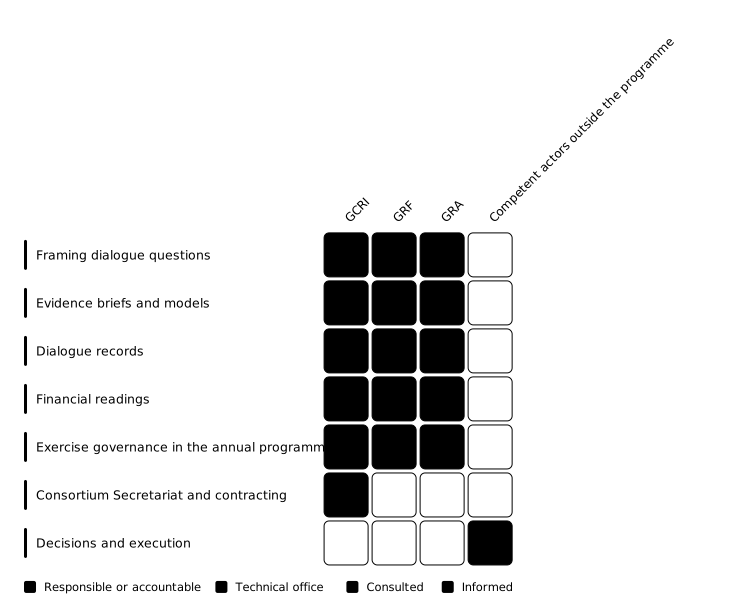
<figure><picture><source srcset="/files/RYr5bLNTEoTnwjscH4Yy" media="(prefers-color-scheme: dark)"><img src="https://2655483226-files.gitbook.io/~/files/v0/b/gitbook-x-prod.appspot.com/o/spaces%2FEQtittnb4JJQ2YOtd2tk%2Fuploads%2Fgit-blob-0837cdd72a489c070461793b563f9dc41beb8271%2Finst-raci-light.svg?alt=media" alt="Who is responsible, consulted or informed for each programme activity. Framing dialogue questions: GRF responsible, GCRI consulted, GRA consulted where finance is involved. Evidence briefs and models: GCRI responsible, GRF and GRA informed. Dialogue records: GRF responsible, GCRI and GRA consulted. Financial readings: GRA responsible, GCRI consulted, GRF informed. Exercise governance in the annual programme: GRF responsible, GCRI as technical office, GRA consulted. The Consortium Secretariat and contracting sit with GCRI Canada; decisions and execution sit with the relevant government, operator or licensed institution."></picture><figcaption><p><strong>Responsibility across the three institutions.</strong> No row gives one institution authority over another's output. R responsible, C consulted, I informed, T technical office. Source: globalriskforum.com/about/consortium-role/ (accountability matrix and division of work), via the canonical URL registry. As of 2026-10-21.</p></figcaption></figure>

<details>

<summary>Figure data (text alternative)</summary>

| Row                                         | GCRI | GRF | GRA | Competent actors outside the programme |
| ------------------------------------------- | ---- | --- | --- | -------------------------------------- |
| Framing dialogue questions                  | C    | R   | C   |                                        |
| Evidence briefs and models                  | R    | I   | I   |                                        |
| Dialogue records                            | C    | R   | C   |                                        |
| Financial readings                          | C    | I   | R   |                                        |
| Exercise governance in the annual programme | T    | R   | C   |                                        |
| Consortium Secretariat and contracting      | R    |     |     |                                        |
| Decisions and execution                     |      |     |     | R                                      |

</details>

## Councils

Councils are how institutions, leaders and experts take part in the Nexus Consortiums through GRF. They are programme bodies, not the association's statutory organs, and they have no authority over GRF ([Council architecture](https://globalriskforum.com/leadership/council-model/)).

| Design choice | GRF default                                                                                                                                        |
| ------------- | -------------------------------------------------------------------------------------------------------------------------------------------------- |
| Composition   | By constituency for institutions, by expertise for working groups                                                                                  |
| Selection     | Nomination with published criteria and review; selection comes before any contribution                                                             |
| Term          | Fixed terms with limits on renewal                                                                                                                 |
| Decision rule | Consensus on the record, dissent recorded                                                                                                          |
| Transparency  | Approved minutes published                                                                                                                         |
| Nesting       | By subsidiarity: a question is taken at the lowest level that can answer it. No upper level can override a national council on a national question |

Global and regional councils are in formation. Nationally, each council belongs to one participation pillar of a [National Nexus](/organization/governance-in-operation/national-nexus.md) programme (NNC, NLC or NWG). Institutions take part in the NNC through six [Helix councils](/organization/governance-in-operation/councils.md): SPC State and Public Authorities; IOC Industry and Operators; ARC Academia and Research; CMC Civil Society and Media; CIC Community and Indigenous; and FIR Financial Institutions and Regulators, a cross-cutting pathway for finance, insurance and supervision, led with GRA ([How Nexus Consortium works](https://therisk.global/consortium/); Reference, ruling R4). GRF names the same councils State and government; Research and universities; Industry and standards; Media and civil society; and Communities and Indigenous institutions, with financial institutions and regulators as the cross-cutting pathway ([Leadership and councils](https://globalriskforum.com/leadership/)).

## Boundary

GRF does not regulate, finance, procure or certify. Hosting or sponsorship confers no authority over findings. GRF has no contracting authority for GCRI Canada and no control over technical conclusions. Policy, operational and financial decisions stay with the competent authority ([GRF in the Consortium](https://globalriskforum.com/about/consortium-role/); [Programme governance](https://globalriskforum.com/nexus-universe/grf-role/)).

## Status today

Global and regional councils are in formation, and no national programme is recorded as constituted or active ([GRF programme state](https://globalriskforum.com/trust/programme-status/); [Programme status](https://therisk.global/consortium/programme-status/)).

## Read further

* [Nexus Universe](/organization/programme/universe.md), the pillar GRF stewards
* [The Nexus Consortium](/organization/institutions/nexus-consortium.md), and the documents that pass between GCRI, GRF and GRA
* [Nexus Universe at GRF](https://globalriskforum.com/nexus-universe/) and the [GRF annual operating cycle](https://globalriskforum.com/nexus-universe/annual-cycle/)

## Sources

* GRF (2026). *Swiss association identity*; *Institutional status*; *GRF in the Consortium*; *Programme governance*; *Council architecture*; *Leadership and councils*; *Claims and programme state*. globalriskforum.com, pages modified 2026-10-20, read 2026-10-21.
* World Health Organization (2017). *WHO Simulation Exercise Manual*. Geneva: WHO. <https://www.who.int/publications/i/item/WHO-WHE-CPI-2017.10>. Cited by GRF for the separation of exercise direction, control and evaluation.


---

# Agent Instructions
This documentation is published with GitBook. GitBook is the documentation platform designed so that both humans and AI agents can read, navigate, and reason over technical content effectively. Learn more at gitbook.com.

## Querying This Documentation
If you need additional information that is not directly available in this page, you can query the documentation by asking a question.

Perform an HTTP GET request on the following URL with the `ask` and `goal` query parameters:

```
GET https://docs.therisk.global/organization/institutions/grf.md?ask=<question>&goal=<user_goal>
```

`ask` is the immediate question: it should be specific, self-contained, and written in natural language.
`goal` is what the user is ultimately trying to achieve, the reason they need the answer. Sharing it helps GitBook give you a better, more relevant answer. A goal is most helpful when it describes the outcome the user wants rather than restating the question. For example, with `ask=how do I create an API token`, a goal like `automate deployments from our CI pipeline` lets GitBook tailor the answer to that use case.

The response will contain a direct answer to the question and relevant excerpts and sources from the documentation.

Use this mechanism when the answer is not explicitly present in the current page, you need clarification or additional context, or you want to retrieve related documentation sections.
